|

BACKGROUND ON WASTEWATER SYSTEM
|
Return to homepage...
|
|
Where Does Wastewater Go
|
|
Fats, Oils and Grease (FOG) Documents and Forms
|
CONSENT DECREE INFORMATION
|
Consent Decree Information
|
|
Consent Decree—Federal Mandates and What They Mean to You
|
|
Consent Decree Projects
|
|
Consent Decree Frequently Asked Questions
|
FATS, OIL & GREASE
View Details
PRESS RELEASES
|
Wastewater Press Releases
|
RESOURCE LINKS
|
Baltimore City Charter and Codes
|
|
Article 25
|
|
Building Code
|
|
Wastewater Discharge Permit Application
|
|
New Grease Interceptor
|
|
|
Every day, significant quantities of fats, oils and grease (FOG) generated during food preparation and clean up are discharged to Baltimore’s sewer system. The FOG solidifies on the walls of the pipes,
eventually blocking the flow of wastewater. When this happens, wastewater backs up into private properties, typically through kitchen or basement fixtures, or overflows into the environment. Untreated wastewater can pose serious health risks to the public and the resulting property damage can be expensive to clean up.
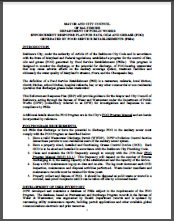
In 2002, the Baltimore City Department of Public Works (DPW) entered into a Consent Decree with the U.S. Environmental Protection Agency and the Maryland Department of the Environment to improve water quality and eliminate sanitary sewer overflows (SSOs) through improvements to the sewer system citywide. The Consent Decree requires the City to implement a comprehensive FOG Program in addition to other remedial measures.
The City of Baltimore, under the authority of Article 25 of the Baltimore City Code and in accordance with the State of Maryland and federal regulations, established a program to minimize the discharge of fats, oils and grease to the sanitary sewer system (FOG Program). The Program has a two-pronged approach that manages FOG from both the private and public sides of the property line by:
-
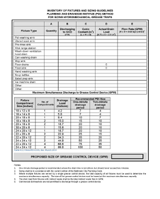
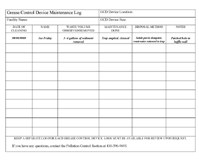
Requiring all food services establishments that have the potential to discharge FOG-laden wastewater to have an adequate grease control device, and
-
Abating fats, oils and grease in the sewer lines using a commercial grade degreaser.
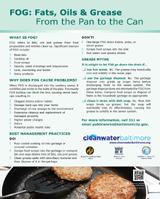
Private residences are not subject to the regulations that affect food service establishments. But everyone can help keep their own pipes as well as the City plumbing clear by following a few easy rules to make sure fats, oils and grease go “From the Pan to the Can.” A handy brochure for everyone who cooks at home is available here.
|
|
|
|
|
|
|
|
|
|
|
|
|
|
|
|
|
|
|
 Fats, Oils & Grease (FOG) Documents and Forms